At some point, every growing product hits the same question: How do we scale engineering without breaking delivery?
Most teams are offered two answers – staff augmentation or a dedicated team. They sound similar. They are not.
Treating these models as interchangeable is one of the most common and expensive mistakes in outsourcing. The wrong choice doesn’t just slow teams down, it creates hidden costs, blurs ownership, and quietly erodes accountability.
Both models give you access to remote engineers. That’s where the similarity ends. What differs is who owns the work, who makes decisions, and who carries the risk when things go wrong.
In this article, we break down staff augmentation and dedicated teams as they actually work in real projects, where each model shines, where it fails, and how to choose the one that fits your stage instead of fighting it.
What is staff augmentation?
Let’s say you already have a team, but at a certain point, you require additional capacity or a specific skill – a QA automation engineer, a cloud expert, a DevOps engineer, etc. This is a common use case of staff augmentation.
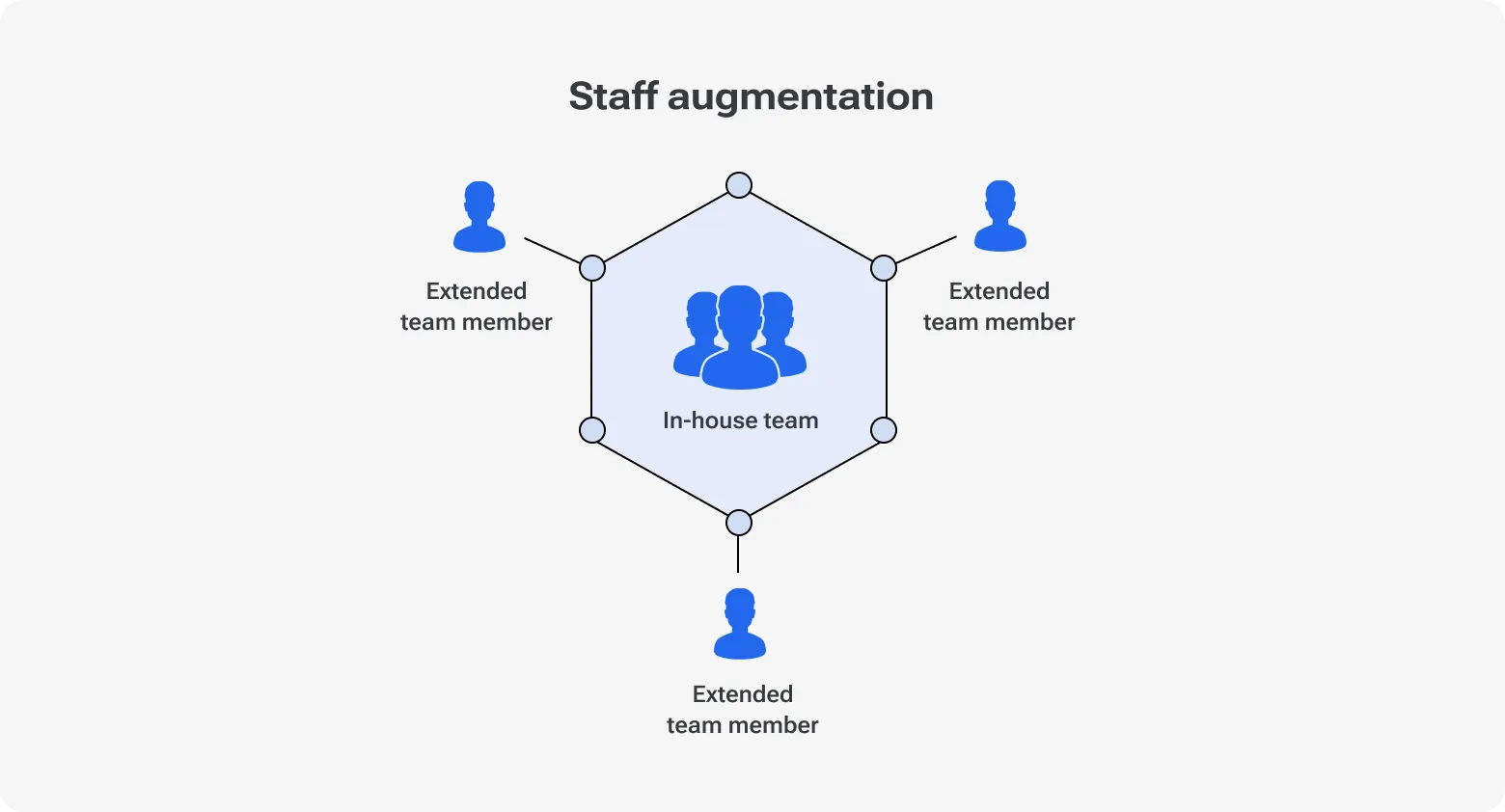
Instead of hiring full-time or handing the work off to an external vendor, you just bring in individual specialists from outside and integrate them right into your internal product team. These people participate in the team’s meetings, use the tools you use, and work against your backlog. Daily, they contribute just like your regular in-house engineers, not as a separate unit.
The key aspect here is ownership. With staff augmentation, you keep it. Your company sets key goals, priorities, timelines, and delivery expectations. As for the external provider, they just supply talent and tackle administrative overhead – that's the extent of their responsibility.
So, staff augmentation works this way:
External experts join your existing team
Product ownership and technical decisions are still internal
The company defines priorities, deadlines, and the scope of work
The vendor is responsible for staffing
This approach is suitable when teams want to move faster without changing how processes are organized. In fact, 62% of companies use staff augmentation to manage dynamic workloads, while 58% prioritize it because of quick access to specialized skills.
Yet, it's worth mentioning that staff augmentation struggles when internal teams have weak leadership, rushed onboarding, and ever-changing requirements. In this case, augmented specialists, irrespective of seniority, wait for direction instead of doing their job.
Motivated and focused experts for up to 60% less than locals, delivered in days, not months
What is a dedicated team?
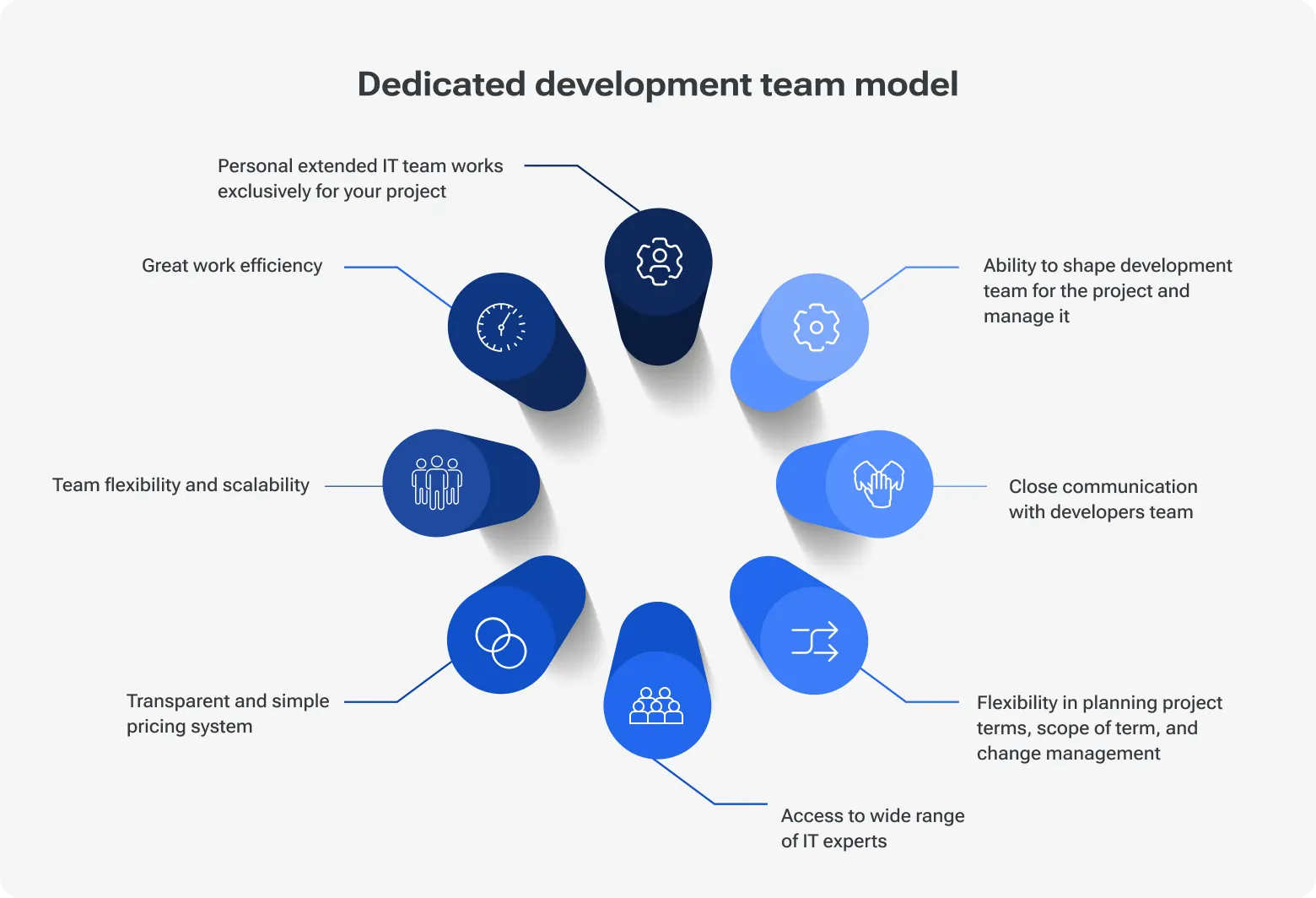
A dedicated team is an outsourcing model where a vendor provides a remote team of tech specialists who work exclusively on a client’s project full-time.
It’s suitable when you need not just a pair of extra hands to strengthen your team but a separate full-fledged team to handle a subsystem, a product line, or a long-running stream of work. A vendor provides such a squad pretty quickly in the composition that you need. Usually, it includes:
Though spread across different locations, team members work together as a unit responsible for delivery. Roles are defined, communication patterns are established, processes are set up, and collaboration doesn’t depend on constant input from your side.
Being self-contained, such remote engineering teams handle planning, technical choices, execution, and day-to-day coordination internally. You stay involved at the product level, without having to provide daily hand-holding to move forward. That shift in ownership is what makes dedicated teams different.
However, this model is challenged when expectations are vague or when a context isn’t shared. Without a clear product vision and regular checkpoints, distance fosters misunderstandings rather than smoothing them out.
When the foundations are solid, though, a dedicated team functions more like a part of the organization that just happens to work from different places.
Productivity frameworks for distributed augmented teams
Staff augmentation vs. dedicated teams: Key differences explained
Staff augmentation and dedicated teams have similarities. In both cases, a vendor is involved, people work remotely, and the goal is to keep delivery moving without overloading the internal team. Still, there are also a lot of differences, and a dedicated team vs. staff augmentation comparison zooms in on them to enable you to make the right choice.
1. Engineering team structures and day-to-day workflows
Staff augmentation strengthens and extends an existing structure. There is already a team, a process, and a way of working, and augmented specialists step into that environment and adapt to it. The delivery pattern stays the same; there are simply more people following it.
A dedicated team comes with its own internal structure. People, collaboration patterns, and coordination are all internal. That makes it closer to running an additional team than expanding an existing one.
2. Management overhead
While staff augmentation reduces the effort of hiring, it doesn’t remove the need for internal management. Every augmented specialist still needs your day-to-day guidance in terms of direction, task prioritization, etc.
Internal leads spend time onboarding, reviewing work, and ensuring alignment – more people on the team translate into more coordination effort. No wonder that an average manager spends 17.9 hours per week in meetings, which is 7 hours more than engineers do.
If you use a dedicated team, much of that burden falls on the vendor. Because the team is self-contained, management and coordination happen within the team itself. Your organization provides product goals and boundaries without the need to manage daily work. This way, dedicated teams are particularly valuable when internal management bandwidth is limited.
3. Ownership and responsibility
With staff augmentation, ownership is always on your side. Augmented specialists contribute to the project, but direction, prioritization, and responsibility for outcomes stay with your internal leads. If something goes wrong, it’s your team that adjusts scope, redefines priorities, or bears the pressure.
When it comes to the dedicated development team model, responsibility for delivery is on the team itself. Planning, coordination, execution, and internal decision-making don’t require guidance or supervision from your organization. You define the product goals and constraints, but the team figures out how to deliver working solutions.
4. Scalability and flexibility
Staff augmentation is all about flexibility. For example, adding two full-stack engineers for three months is as easy as scaling down after a release. This model is designed exactly for short-term or fluctuating needs.
Dedicated teams, in comparison, suggest a longer-term commitment. They’re a better fit for long-running initiatives where team stability, shared context, and continuity are top priorities.
5. Knowledge retention
When you use staff augmentation, your internal team needs to do onboarding and explain processes. Yet, when the engagement ends, augmented specialists often leave along with the context and expertise they carried. This can result in fragmented knowledge.
Dedicated teams retain knowledge within the team itself. Since the team works together for a certain time and owns end-to-end delivery, technical decisions, processes, and expertise stay within this team. As a result, the team can work independently and maintain continuity. The downside is that the product knowledge remains with the dedicated team rather than becoming part of the internal organization.
6. Cost structure
Using staff augmentation, you pay an hourly or monthly rate for individuals, avoiding long-term commitments. For temporary or narrowly defined needs, this works really well.
Dedicated teams, in turn, require high upfront investment because you’re funding a complete team, not just individual roles. However, once the team is in place, costs become more predictable.
In spite of certain similarities, staff augmentation and dedicated teams differ in ownership, structure, flexibility, and management. Understanding these distinctions, you can pick a model that matches your project needs and internal capabilities.
When to use staff augmentation
No outsourcing is actually universal. Therefore, you need to know when each one works better. As to staff augmentation, it’s the right choice when you already have a good delivery engine and just need to reinforce it without outsourcing responsibility.
Staff augmentation is usually the right fit if:
1. You need specific skills, not a whole team.
For example, a DevOps engineer to stabilize infrastructure, a QA automation specialist to speed up regression, or a senior backend developer to handle a narrow technical challenge.
2. You have strong engineering leadership in place.
There should be someone on your side to set direction, review work, and keep everyone aligned. Without internal leads, augmented specialists often wait for input instead of digging into the work.
3. You need flexibility in scaling up or down.
Using staff augmentation, you can easily add capacity for a release, a migration, or a busy quarter and reduce it later painlessly.
4. You want a lower short-term cost.
Staff augmentation allows you to bring in top specialists for a limited period without committing to long-term salaries, benefits, or retention costs. For many teams, this results in access to strong expertise at a more affordable cost.
5. Product decisions, roadmap, and architecture stay internal.
Your team defines what to build, how, and why. Augmented specialists execute within that framework.
6. You prefer control over day-to-day execution.
Task assignment, priorities, and delivery timing remain under your direct supervision.
When dedicated teams are the better choice
Dedicated teams deserve your attention when you lack bandwidth, structure, or delivery capacity and want to bring in a team that can own a substantial slice of work and handle it with minimal supervision.
A dedicated team is the better option if:
Instead of assembling roles one by one, you get a complete team that’s already aligned and used to delivering together.
When there’s no strong tech lead available internally, a dedicated team can come with its own leadership as part of the setup, enabling autonomous work.
Offshore or nearshore dedicated teams work well when you have multiple initiatives moving at the same time, for example, core product development alongside a new feature set or a separate product line.
That’s exactly what this outsourcing model offers. Because the team handles planning, coordination, and execution on its own, delivery becomes more reliable without adding pressure on internal managers.
A dedicated team brings its own processes, communication patterns, and routines, helping stabilize delivery when internal teams are stretched thin.
Dedicated teams are built for ongoing work, where context and responsibility stay with the team over time rather than being reset every few months. As a rule, dedicated engagements run 12-24 months or longer, with retention rates often exceeding 85%.
Avoid operational and HR hassle and the constant threat of attrition with your own R+D department from Devico
When neither model works – edge cases
There are situations where neither of the discussed models delivers the outcome you expect – no matter how proficient and reliable the vendor is.
The edge cases you need to know:
When goals change weekly or the idea isn’t clearly defined, external individuals or teams struggle to move forward. Both models require some level of direction.
If project knowledge lives only in people’s heads and there’s no baseline for how work is done, onboarding becomes slow and error-prone, regardless of the model.
Staff augmentation needs internal direction, while dedicated teams need space to lead. When neither is possible, delivery holds up, as no one truly owns outcomes.
Growing a team by 20 or more engineers in a very short time frame isn’t within the capabilities of either model. Onboarding, alignment, and quality control become bottlenecks before delivery gains momentum.
Domains that require on-site presence, strict compliance, or physical access to infrastructure often can’t rely fully on remote or dedicated specialists.
In these cases, you can consider alternative approaches:
Dedicated delivery centers provide teams built with longer-term alignment, stronger governance, and deeper integration into your organization.
In-house hiring is the best option when knowledge ownership, compliance, or long-term stability outweighs speed or flexibility.
Managed delivery lets you fully delegate responsibility for outcomes, timelines, and quality to a vendor under clearly defined SLAs.
There is an abundance of outsourcing models. Which one to choose depends on your product’s maturity, constraints, and appetite for ownership.
Final thoughts
There is no universally better model. There is only a better decision for your current reality.
Staff augmentation works when you already know where you’re going and just need more horsepower. Dedicated teams work when you need a system, not just people, to carry part of the load.
Problems start when teams try to buy flexibility but lack leadership, or buy autonomy without clarity. In both cases, the model gets blamed for what is actually a structural issue.
The right choice depends on how much ownership you’re ready to keep, how much responsibility you’re willing to delegate, and how clearly you can articulate the work ahead.
If you want a second opinion, Devico’s team helps assess their setup and choose a scaling model that fits their product stage, before costs and complexity lock in.
Choose the model that matches your maturity, not the one that sounds easier on paper.