Cost pressure makes the decision obvious. Risk makes it hard.
Leaders worry about lost knowledge, slower releases, and unstable ownership, and for good reason. That’s exactly what happens when outsourcing is done wrong.
Done right, it doesn’t stall delivery. It stabilizes it.
This guide shows how to replace in-house developers with outsourced teams while keeping velocity, quality, and control intact.
Why companies transition from in-house to outsourced devs
52% of businesses see great opportunities in hybrid models combining in-house and outsourced development. So what makes executives turn to outsourced developers? In reality, there are plenty of practical reasons.
1. Cost optimization without losing velocity
Outsourcing lets you bring in top-tier specialists at a fraction of the cost. You save money while keeping release speed intact. When properly introduced, outsourcing helps companies cut labor costs by 60-90%.
2. Shortage of local talent
Instead of spending months searching for experienced developers locally, it’s better to apply to an outsourcing company that already has senior engineers on the bench, allowing you to skip the recruiting hurdle and move straight to execution. In fact, 62% of US-based enterprises use outsourcing to access seasoned software developers across different geographies.
3. The need to scale specific skills fast
Outsourcing gives you quick access to specialists exactly when they’re needed without turning every short-term need into a long-term hire.
4. Burning out of internal teams
When your in-house team scrambles between building features, fixing legacy issues, and supporting production, outsourced developers can jump in to take on part of that load, letting internal developers stay productive and deliver quality results.
5. Product roadmap pressure
Investors, users, and the market don’t care about hiring challenges. When timelines are tight and expectations are high, outsourcing is often the only way to keep the roadmap moving. Thus, 44% of outsourcing clients say speed-to-market is their primary motivation.
6. A push for better process discipline
Professional outsourcing teams live and die by documentation, predictable delivery, clear ownership, and transparent reporting. For many companies, this external structure drives significant improvements in planning, communication, and accountability across the entire delivery process.
Outsourcing isn’t just a cost-cutting opportunity. It may be a strategic extension of the team, bringing real value. If you want to succeed with software development outsourcing instead of swapping people, you need to redesign how work is owned, shared, and delivered.
🎧 Listen to The Devico Breakfast Bar episode with Matt Fain, the сo-founder and CEO of PopCapacity, as a guest to learn how to make the right choice between in-house and outsourced dev teams.
Great software starts with great people
Common fears around replacing in-house devs and why they become reality
If you’re considering outsourcing, you already know the benefits. What holds teams back are the failure stories. Those risks are real and predictable when they’re not managed upfront.
Let’s break down the most common fears around outsourced developers and why they occur.
1. ‘Outsourced developers won’t understand the product.’
This concern is reasonable only if product decisions, edge cases, priorities, and nuances aren’t clearly articulated and documented. In this case, any new team, whether outsourced or internal, is doomed to fail.
2. ‘We’ll lose knowledge.’
Without a structured handover from internal devs leaving a team, the product history, rationale, and technical shortcuts that never made it into docs get lost. Besides, some leaders worry that, over time, outsourced developers may know a system better than internal teams, creating a dependency on external expertise. Both risks are real, but the right onboarding and documentation practices can mitigate them.
3. ‘Delivery will slow down.’
You will notice a temporary slowing down anyway. That’s the norm. Any newcomer needs some time to get up to speed. So, it’s a mistake to underestimate onboarding time and expect immediate efficiency. Delays do appear at the ramp-up phase, but with appropriate planning, delivery quickly returns to schedule.
4. ‘Communication will become harder.’
Communication can get messy when time zone overlap, English level, and working habits aren’t considered when choosing an outsourcing partner. However, clear communication channels, overlapping hours, language proficiency, and agreed-upon processes make communication efficient.
5. ‘Quality will drop.’
As a rule, issues pop up when quality expectations are implicit. Without clearly defined coding standards, testing depth, and acceptance criteria, outsourced developers may deliver exactly what was asked, which, in turn, is far less than what the product needs.
6. ‘We’ll have to micromanage everything.’
Team babysitting often comes from unclear roles and responsibilities. When it’s not obvious who owns what, managers find themselves frequently answering questions, clarifying priorities, and making decisions that the team should handle. The problem isn’t the outsourced developers but the working process. With clear accountability and defined workflows, outsourced developers work independently, and you don’t need to micromanage.
From what we’ve seen in our practice, all of these fears are reasonable. They happen when companies introduce outsourcing without rethinking their approach to knowledge transfer, onboarding, ownership, communication, and delivery.
A proven approach to replacing in-house developers without delivery risk
Is there a chance of cutting a finger when slicing bread? Sure, but in most cases, people avoid injuries because they know how to handle a knife. The same applies to outsourcing - when you understand how to adopt it safely, you reap benefits without disruptions.
Having been in outsourcing for many years, we’d love to share a structured approach to replacing in-house developers that can help you avoid common pitfalls.
Step 1. Define roles that can be safely replaced
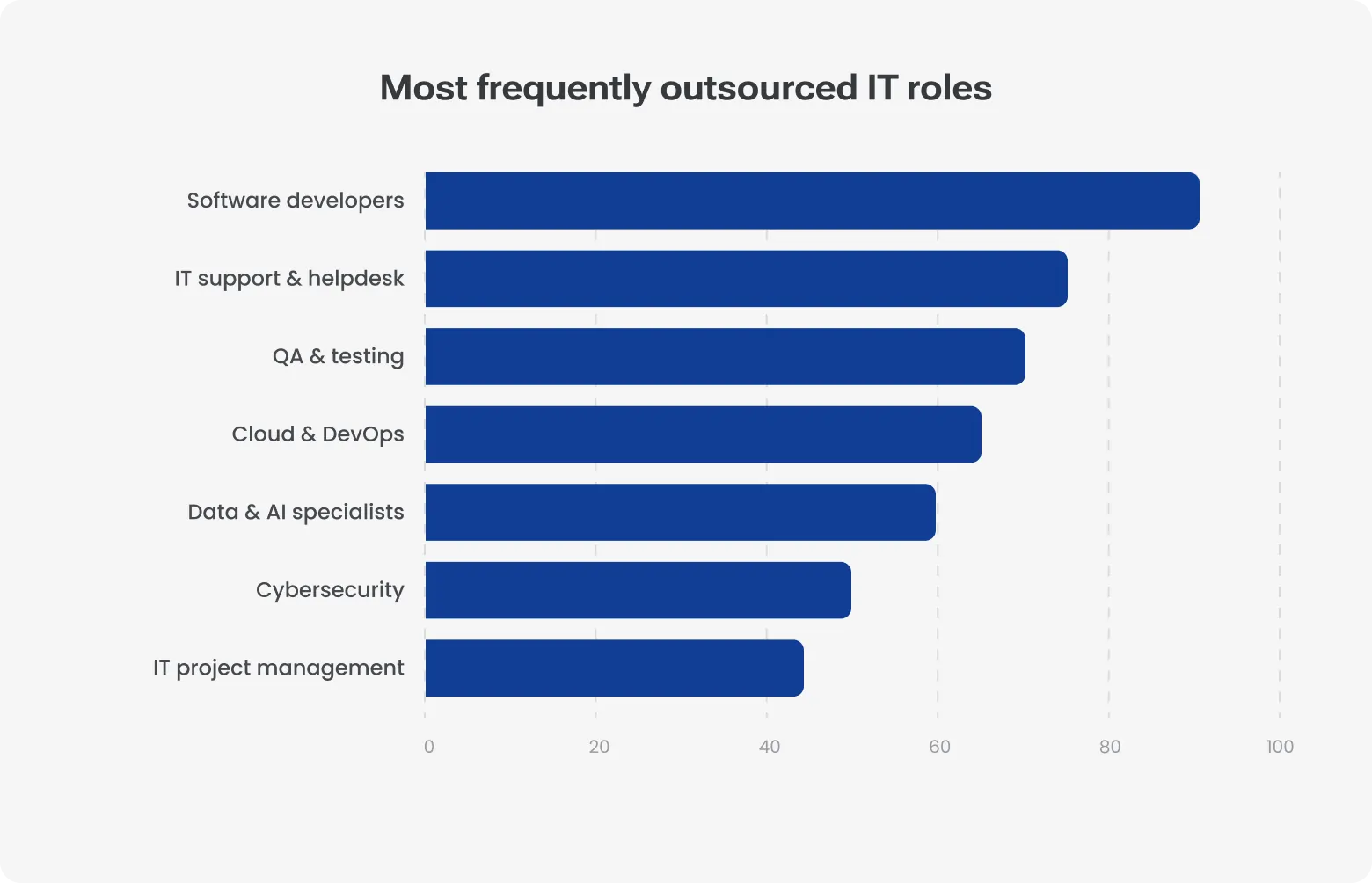
Outsource or not to outsource isn't a question. What to outsource – it is.
Source: Euro IT Sourcing
Not all roles can be outsourced equally safely. Moreover, some shouldn't be outsourced at all. The trick is knowing the difference. At Devico, we know it and are ready to share it with you.
Roles perfect for outsourcing
FE and BE developers tackling microservices, standalone system modules, integrations, or APIs with clear boundaries are ideal roles for outsourcing. Not requiring immediate full-system knowledge, they can be onboarded pretty quickly.
Bug fixing, refactoring, or support of legacy systems can often be outsourced seamlessly, especially when the codebase doesn’t evolve rapidly.
If you need a real expert for backend optimization, performance tuning, DevOps automation, or assistance with a specific tech stack for a limited time, outsourcing is the best option. Hiring these skills full-time rarely makes sense.
Roles to be better kept in-house
People defining architecture, picking technologies, and setting long-term technical direction should be internal. Tightly connected to business strategy and product vision, these decisions should remain under internal ownership.
If a developer knows why things were built a certain way and that knowledge is kept in their head only, replacing them without serious preparation is too risky.
Developers who work closely with PMs, designers, and stakeholders day by day or mentor other engineers are usually harder to replace without redesigning workflows first
If someone works on the most sensitive, complex, or business-critical parts of the system, outsourcing should be gradual and controlled. A quick switch isn’t a good idea.
Changing people out randomly has nothing to do with successful outsourcing. It comes down to how close a role is to key decisions, undocumented knowledge, and daily collaboration. The less a role is tied to those areas, the easier it is to outsource without breaking delivery.
Step 2. Prepare a structured knowledge transfer plan
Research shows that 74% of companies have no formal approach to knowledge transfer. That’s interesting because weak handover is where most outsourcing transitions quietly fall apart. And the biggest mistake companies make is assuming knowledge transfer can happen after the new team joins. No, it must start before the transition, while the internal team is still around and fully engaged.
To be well-prepared for transition, you need to design a proper knowledge transfer plan, which at a minimum should include the following:
Apart from telling what the system does, you must explain why it was built this way, outlining key architectural decisions, trade-offs, rejected approaches, and known constraints.
Walk newcomers through the architecture, dependencies, data flows, and fragile areas. Also, it’s equally important to explain who owns what. When ownership is fuzzy, delivery quickly slows down.
Apart from happy paths, document also edge cases. Your plan should explicitly cover failure scenarios, non-obvious business rules, and areas where the system behaves differently than expected. If these aren’t explained upfront, the new team will discover them the hard way.
Outsourced developers must understand how work is actually done on the project. Spell out coding standards, branching strategy, release cadence, quality expectations, and what ‘done’ means in practice.
Documentation is always of great help, but it’s never enough on its own. Live walkthroughs, screen sharing, paired coding, and open Q&A sessions are also paramount. This is where the stuff that never makes it into Confluence is revealed and discussed.
Define a period within which internal and outsourced developers work side by side. Even a limited overlap prevents confusion once the handover is officially over.
If knowledge transfer is rushed or postponed, outsourcing will feel messy, no matter how good the team is. When it’s planned early and done properly, the transition is seamless.
Step 3. Arrange a joint delivery period
As we mentioned above, a short overlap between internal and outsourced teams is a part of knowledge transfer. In fact, you may consider it as a ‘buddy period’ that makes the transition smoother.
Why this joint delivery period matters:
Internal and outsourced developers work shoulder to shoulder. The internal team is always there to answer questions, explain decisions, and point out unobvious things.
Knowledge transfers naturally. Business logic, coding standards, and internal practices are picked up through real work, not documents.
Slowdowns are minimized. Instead of hitting the ground cold, the new developers ramp up gradually while work goes on.
Leadership can evaluate collaboration and quality. Before internal developers step away, managers can assess how well the external team completes tasks and interacts.
In most cases, three weeks is enough for joint delivery, and the setup looks like this:
Week 1 for shadowing: The outsourced devs keep an eye on how work on the project gets done: standups, planning, reviews, releases, etc. At this stage, they mostly listen and ask questions.
Week 2 for paired work: Both teams handle tasks together, pairing on code, reviewing each other’s work, and asking questions.
Week 3 for taking ownership: The outsourced developers complete tasks end-to-end, while the internal team remains available if needed.
Step 4. Strengthen process discipline to prevent chaos
Discipline lays the groundwork for order and efficiency. While it suggests some bureaucracy, it also serves as a safety net when part of the team is new or external. A strong delivery process takes the guesswork out of daily work, keeps things organized, and makes bringing in a new team easier.
Here’s what needs to be set up first if you have the intention to replace in-house developers:
Standups help teams control progress, expose blockers early, align priorities, and catch misunderstandings before they turn into bigger issues. When outsourced developers join, these daily syncs are a must.
Vague tasks can get by when everyone shares context. During transition, they can cause real problems. Clear descriptions, acceptance criteria, and edge cases are what you need to prevent rework and frustration on both sides.
Who creates branches, how often they merge, and what goes where shouldn’t be up for debate. A shared branching strategy is the best way to avoid broken builds, conflicting changes, urgent hotfixes, and other headaches.
Reviews aren’t about control only. They’re also how standards are reinforced and context is shared. With their help, internal developers can see how the outsourced team thinks and vice versa.
Automated checks, test coverage expectations, clear quality thresholds – all of these protect the product throughout development, and especially when team composition changes.
Planning keeps priorities aligned. Retrospectives reveal what’s breaking before it turns into a habit. Skipping either usually results in delivery issues later.
Everyone should know who owns what. It refers to features, services, releases, incidents, etc. When ownership is clear, the work of managers as well as the entire team is more efficient and easier.
When team members change, intuition can’t be the glue holding delivery together. A clear process takes that role instead, keeping work moving even when the team is in transition.
Step 5. Set up clear communication loops
Clear communication is essential for any team. Yet, its importance increases geometrically when switching from in-house to outsourcing. In this setup, efficient communication isn’t a nice-to-have. It’s what makes collaboration and work progress possible. And it comes down not only to the daily standups we mentioned above. Here’s what needs to be set up on the communication side:
Weekly roadmap sync – a quick alignment meeting to review upcoming priorities, clarify deadlines, and make sure internal and external teams know what’s important for the week.
Biweekly engineering review – a deeper session to discuss completed work, tackle technical challenges, and review code or system decisions.
Clear escalation path – to stop small delays from becoming big ones, everyone should know exactly who to contact when blockers appear.
Defined SLAs for questions – set expectations for response times, so decisions don’t wait overnight, and work keeps moving across time zones.
Single source of truth – centralize all project-related documentation in one place, let’s say Jira, Linear, Notion, or Confluence, in order that no one wastes time hunting for the latest info.
Communication guidelines – agree on a suitable level of English, async vs. synchronous rules, and preferred communication channels to prevent misunderstandings before they arise.
According to the National Institute of Standards and Technology, 43% of companies report challenges in communication with offshore teams. Yet, that’s rarely about outsourcing itself. It’s what happens when communication loops aren’t set up properly. Once they are, uncertainty disappears. Everyone knows what to do, who to ask, and where to find information. As a result, work flows, and progress doesn’t get stuck.
Step 6. Monitor performance early and often
In God we trust, the rest we check – that’s how smart businesses work. Get it right: we don't promote total control or micromanagement, but regular, and importantly, early performance checks to make sure your outsourcing team meets your expectations.
Key metrics to track
Output quality
Evaluate code readability, test coverage, edge-case handling, and how often fixes create new issues.
Check if outsourced developers quickly grasp business logic, tooling, product nuances, and domain specifics.
Make sure new developers can clearly articulate their thoughts, without others having to decode their messages.
Pay attention to whether developers voice problems, detect areas for improvement, and offer efficient solutions and new ideas
When tasks are completed without reminders, deadlines are respected, and issues are raised before they turn critical, you can rely on the team.
Alignment with team culture
Assess how the outsourced developers interact with internal teams during reviews, planning, contradictions, and day-to-day discussions.
Note that a trusted outsourcing partner doesn’t leave this monitoring entirely on your side. Engineering leads or delivery managers get involved, tracking progress, addressing gaps early, and keeping quality standards steady.
Step 7. Gradually shift full responsibility to the outsourced team
Transitions may stumble for different reasons, but far too often this happens because responsibility is handed over too quickly. Don’t rush – a phased approach that builds confidence on both sides works best.
Devico has supported numerous projects across different sizes and stages. Based on our participation in numerous transitions, we recommend the following strategy:
- Begin with low-risk tasks
First, let outsourced developers tackle bug fixes, small enhancements, low-impact integrations, or non-critical services. This way, they learn the codebase, understand your workflows, and show reliability without putting delivery at risk.
- Move to more critical features
Once you see no problems with the basics, it’s time to handle larger features and more critical parts of the system. At this stage, you may expect new developers to not only accomplish assigned tasks but also make some tech decisions.
- Hand over recurring responsibilities
To minimize involvement of internal developers, allow an outsourcing team to take on routine work: release preparation, system maintenance, tech debt handling, etc.
- Establish clear code ownership
Make sure every outsourced developer is well aware of which services, modules, or features they own. Ownership in this case means not only writing the code but also maintaining it through ongoing fixes and improvements.
- Shift the internal team’s role to oversight
Internal developers don’t disappear. Now, they focus on supervision, reviewing outcomes, and jumping in only when strategic decisions are needed.
Thanks to gradual responsibility transferring, both internal and external teams stay stress-free, and delivery stays on schedule.
Signs the transition is successful
You usually don’t need special dashboards or reports to know whether switching from in-house to outsourcing has worked out. It’s just felt in day-to-day work, team dynamics, and how often you need to step in. You’ll start noticing the following:
There are no sudden slowdowns. Work moves at the same pace as before, or faster.
Work is in full swing instead of getting stuck waiting for approvals or clarifications.
Each release introduces fewer surprises and fewer bugs.
Milestones are met without quiet compromises or timeline adjustments.
Questions are specific, decisions are quick, and conversations are short and purposeful.
Outsourced engineers spot issues, fix them, and move on without pulling in the internal team.
Do you see all of these on your project after the transition? Congrats – you’ve nailed it.
Red flags your outsourcing vendor isn’t ready for this
Some issues can be spotted only when the transition is underway, but to minimize risks, you need to be on the watch far earlier. If you see red flags with a vendor at the negotiation or kickoff stages, there is a high likelihood things won’t run smoothly. Here are signals that should warn you:
No onboarding plan. If a vendor can’t show a clear onboarding or knowledge-transfer plan upfront, expect early delays and repeated clarifications.
Junior-heavy team. Check team composition early: too many juniors and too few seniors isn’t what you need, especially for critical tasks.
High team turnover. Ask about recent team stability. When faces keep changing, context keeps disappearing, and progress resets more often than it should.
Poor English skills. If the vendor’s team cannot express their thoughts freely, collaboration will suffer – that’s for sure.
No documentation culture. Look for examples of how they document work. Document writing should be in their DNA. Otherwise, knowledge gets lost fast.
No engineering lead or delivery manager. If nobody is assigned to steer the ship from day one, things will bounce around, and issues will pile up.
Purely reactive behavior. Long response time, vague answers, or dependence on instructions signal you should go away from such a vendor.
Unclear pricing and hidden costs. If a vendor’s rates are vague or there are surprises in what’s included, that’s a warning sign right from the start.
Spotting one red flag isn’t always a deal-breaker. Seeing several at once usually is. Be watchful.
Final thoughts: transition without disruption is possible
Replacing part of an in-house team with outsourced developers isn’t a trend. It’s a strategic move many companies have already used to improve stability, control costs, and protect delivery.
The maturity of the outsourcing market proves the model works when the transition is handled properly. The real differentiator isn’t whether you outsource, but how and with whom.
At Devico, we help teams replace internal capacity with minimal disruption and clear operational gains. Senior engineers, structured onboarding, predictable delivery, and long-term ownership – not short-term staffing.
If you’re considering the move, the transition doesn’t have to be risky. Done right, it becomes an advantage.
Motivated and focused experts for up to 60% less than locals, delivered in days, not months